Showing posts with label new modified cars. Show all posts

Thursday, October 21, 2010

2013 SuperCar BMW Megacity

BMW released few details and photos with the new model called Megacity that will be an electric 4-seater also known as the “MCV”.
This will be specially created for city traffic and will have a 100 kw electric engine.

BMW Megacity

The 2013 BMW Megacity uses light materials for the LifeDrive concept, that will help reduce the car’s weight by 250 to 300 kg.

BMW Megacity

Press release:
The BMW Group is once again breaking new ground with the Megacity Vehicle (MCV), due to come onto the market in 2013: “The Megacity Vehicle is a revolutionary automobile. It will be the world’s first volume-produced vehicle with a passenger cell made from carbon. Our LifeDrive architecture is helping us to open a new chapter in automotive lightweight design. Indeed, this concept allows us to practically offset the extra 250 to 350 kilograms of weight typically found in electrically powered vehicles.” says Klaus Draeger, Member of the Board of Management for Development.

“The drive system remains the heartbeat of a car, and that also applies to electric vehicles,” said Draeger. “Powertrains also remain a core area of expertise of Bayerische Motoren Werke. Electromobility and the hallmark BMW driving pleasure make an excellent match, if you go about things the right way. For this reason we are developing the powertrain for the Megacity Vehicle in-house – that includes the electric motor, the power electronics and the battery system.”

The electrification of a vehicle requires new concepts in vehicle architecture and body construction in order to exploit the potential of the new emission-free drive system to optimum effect. With the revolutionary LifeDrive concept, the BMW Group engineers are developing the car’s architecture from scratch and adapting it to the demands and conditions of future mobility. The goal: to offset the additional weight of an electric vehicle – typically 250 to 350 kilograms. To this end, the BMW Group is focusing on the innovative high-tech material carbon fibre reinforced plastic (CFRP).

The LifeDrive concept consists of two horizontally separated, independent modules. The Drive module integrates the battery, drive system and structural and crash functions into a single construction within the chassis. Its partner, the Life module, consists primarily of a high-strength and extremely lightweight passenger cell made from CFRP. Furthermore, the new vehicle architecture opens the door to totally new production processes which are both simpler and more flexible, and use less energy.

The BMW Group is also aiming to be the force behind the best drive systems over the years ahead – systems boasting outstanding efficiency, performance and smoothness, even if it is electricity rather than fossil fuels that are converted into propulsion. To this end, the BMW Group is vigorously driving forward the technical development of electric powertrains. The BMW Group’s centre of expertise for electric drive systems brings together development, manufacturing and procurement specialists under one roof. All their efforts are focused on the implementation and typically BMW interpretation of the new generation of drive systems. Ultimately, electric vehicles not only provide a zero-local-emission and low-noise form of propulsion; their ability to deliver a totally new and extremely agile driving experience is also impressive.

Renault DeZir Concept

Renault DeZir is the latest concept from the French auto-manufacturer which will be officially presented at the 2010 Auto Show in Paris. A French car in Paris is the best choice, don’t you think?

Renault DeZir Concept Video and Review

DeZir Concept has lithium batteries and a 110 kw electric engine at 226 Nm of torque; these batteries can be fully charged in 8 hours.

Renault DeZir Concept Video and Review

Renault DeZir Concept Video and Review

Renault DeZir Concept Video and Review

Renault DeZir Concept Video and Review

Renault DeZir Concept Video and Review

Although it is a “green” car this concept can reach 100 km/h in less than 5 seconds and has a top speed of 180 km/h. Pretty good, no?

2013 Morgan EvaGT - Car News


Image

Morgan, a company perhaps best known for not introducing new cars, showed off a new car just outside the Pebble Beach Concours and promises to bring a new car to market every two years. At this point the Morgan EvaGT is a concept, but the production version will be the first of Morgan’s ambitious product push. Morgan is even taking orders for the 2+2 sports car, and says it will enter production in 2012.

Unlike the historic, ash-framed Morgans, the EvaGT is a fully modern sports car. A bonded aluminum structure shared with the rare Morgan Aero SuperSports helps keep the curb weight down to a claimed 2755 pounds. Powering the EvaGT’s rear wheels is a 306-hp BMW inline-six. (It is unclear whether this is the new single-turbo engine or the older twin-turbo.) Acceleration to 62 mph is said to take 4.5 seconds and the top speed comes in at 170 mph. But, as Morgan tells us, the EvaGT is also about fuel efficiency and will achieve 40 mpg on some undisclosed cycle.

We didn’t immediately think Morgan when we first saw the EvaGT. Without the company’s usual large, round headlamps, the waterfall grille takes on a Bugatti look. The proportions are decidedly pre-war, though, with the enormous hood giving way to a comparatively small passenger compartment. Morgan says that the price will “be competitive for a car of this class,” but we’re not sure that even the most modern Morgan fits into any class in the automotive landscape.

Image

Image

Image

Image

Image

Honda S2000 going hybrid?

2012-honda-s2000-hybrid

The Japan car magazine, Best Car is reporting that the recently discontinued Honda S2000 will return in 2012, but that the new S2000 will be powered by Honda’s second-generation hybrid drivetrain used in the Honda Accord rather than by Honda’s high-revving F20C 2.0-Liter engine. What will probably disappoint fans of the original Honda S2000 more is the news that car will also be front-wheel driven rather than rear wheel drive of its predecessor, although rumors of a front wheel drive Honda S2000 have been circulating since late 2006.

Best Car also reports that the new convertible is likely to be fitted with a retractable hard-top and will be a step up from the all-new Honda CR-Z hybrid due for release in 2010. The new Honda S2000 is thought to make its debut in production form at this year’s Tokyo Motor Show and is expected to be released for sale in the first half of 2012.

Roush Yates to supply EcoBoost V6 for 2011 ALMS Competition


Photos: Lola Cars International

The recently released Ford 3.5-liter, direct injection V6 engine will be modified by Mooresville, NC, engine builder, Roush Yates, for use by Lola Cars in their 2011 LMP2 design. Changes in the class regulations for 2011 require that production-based engines be used. Lola Cars International is the first race car constructor to support the new Ford engine.


“Everyone at Roush Yates Engines is excited to partner with such a prominent car constructor of LMP sports cars,” said John Maddox, Sports Car Program Manager for Roush Yates Engines. “We are proud to build exceptional engines to pair with Lola’s LMP2 design as we enter this innovative championship. Roush Yates Engines plans to use this opportunity to continue improving our technology and efficiency as we strive towards our goal of becoming world-class engine builders.”

The Ecoboost engine will have to have its displacement reduced by ten percent, in order to meet the allowed maximum displacement under American LeMans Series (ALMS) regulations. According to a Roush Yates spokesperson, the modified V6 is expected to deliver around 400 hp. A twin-turbocharged 3.5-liter EcoBoost V-6 engine, as used in the 2010 Taurus SHO, produces 365 hp @ 5,500 rpm while meeting fuel economy and emissions objectives.

In addition to the EcoBoost V6, Roush Yates is reportedly evaluating a race version of Ford’s recently released, 5.0-liter, all-aluminum V8 for ALMS competition in the LMP1 class.

2011 Volvo C30 EV


2011 Volvo C30 EV

2011 Volvo C30 EV

Volvo Cars increases the development of cars powered by electricity - builds electric test fleet


At the Detroit Motor Show, Volvo Cars is presenting a complete battery electric Volvo C30 with a range of 150 km.

The next step forward is to build a test fleet of at least 50 electric Volvo C30s, which will be used in real-life traffic from 2011.

Volvo presented a driveable electric car prototype in September 2009. The C30 now being shown in Detroit takes the company one step further in the development process. It features both a complete interior and full instrumentation, as well as enhanced battery packaging.


'The first prototype helped us identify the main technological challenges, such as battery packaging and safety issues. We have addressed these challenges without compromising the C30's cool and fun-to-drive personality. I am very happy with the result. The electric C30 in Detroit is a much more complete product,' says Lennart Stegland, Director of Volvo Cars Special Vehicles.


The next step in 2010 is a factory-built series of test cars. Selected users will drive the test fleet during a two-year trial period in order to provide Volvo Cars with valuable experience. Not just technical but also behavioural.
The Swedish Energy Agency is supporting the project by contributing SEK 150 million towards its funding.

Valuable field data
A pure electric car has different characteristics compared to a car with an internal combustion engine. Now Volvo's experts will have the opportunity to study how users handle these differences.

'Our test fleet data will be valuable in Volvo Cars' development of electric cars. It will also provide crucial input for the infrastructure planners and help define which services are needed to make rechargeable cars the most attractive choice in the future,' says Lennart Stegland.

New instruments and graphics
The electric C30 looks like a regular Volvo C30 and it offers the very same safety, comfort and roominess as the standard car.

The most obvious difference inside the car is the new instruments facing the driver. The gauges and graphics are somewhat different to those in a conventional Volvo. The cool and user-friendly combined instrument shows in principle only road speed and energy consumption. However, it also integrates a number of new symbols such as a gauge for battery charge status and other relevant information for this type of vehicle.

The driving experience is also different to that in a conventional car. The electric C30 has no gears and the motor's power is delivered seamlessly, with full power available immediately.

'Sailing along virtually without a sound is a very special experience. The power is there instantaneously. We need to spend a lot of time verifying a transmission system that is both comfortable and safe for the driver to handle and at the same time utilizes the battery's capacity optimally at different speeds,' says Lennart Stegland.

Like a regular C30 - all the fun but with no emissions
An electric motor uses about one-fourth as much energy as an engine running on fossil fuels. This superior energy efficiency suggests that interest in electric cars will increase as fuel prices rise and demands for low CO2 emissions become increasingly stringent.

The Volvo C30 shown in Detroit is powered by Lithium-Ion batteries that can be recharged via either a regular household power socket or special roadside charging stations. Charging the battery fully takes about eight hours,
If the car is recharged with renewable electricity, CO2 emissions could be almost zero in the well-to-wheel perspective.

Top speed with a fully charged battery pack is about 130 km/h (81 mph). Acceleration from 0 to 60 mph takes less than 11 seconds. The car's range is up to 150 km (94 miles). This covers the daily transport needs of more than 90 percent of all motorists in Europe.

As safe as all other Volvos
The electric motor is fitted under the bonnet while the batteries (24 kWh) are installed in the propshaft tunnel and in the space normally occupied by the fuel tank, outside the passenger compartment and away from the deformations zones.

'What is more, they are well encapsulated and the structure around them has been reinforced. Electric cars represent yet another interesting challenge in our dedication to building the world's safest cars. An electrically powered Volvo must be as safe as all other new Volvos. And the very same standards also apply to ownership, driving and protection in the event of an accident,' says Thomas Broberg, Senior Safety Advisor at Volvo Cars.

Market prospects for electric power
When it comes to electric-only cars, there are several factors that determine their appeal in the future.

'The consumers must feel that this type of car is attractive both to drive and own. That is why electric cars have to be as comfortable and safe and offer the same sort of performance as cars with other power sources,' says Paul Gustavsson, Director of Electrification Strategy at Volvo Cars.

He continues:
'We believe in this technology and our field test aims to demonstrate that electric cars have considerable market potential. However, offering an attractive car is not enough. What is also needed initially is a system of subsidies to make the electric car's expensive battery technology financially viable for the car buyers. We hope that the authorities and the rest of the society will follow Volvo Cars in our 'Drive Towards Zero' - Volvo Cars' journey towards zero emissions.'


Technical specification Electric C30

Car model:
Volvo C30 - full four seater

Main engine:
Electric engine 40/82KW

Power output:
Electric engine 82kW, 111 bhp

Acceleration 0-100 km/h:
10.5 seconds

Charging duration:
Charging via standard power socket, 230 V, 16 ampere: < 8 hours

Range on electric power:
150 km (NEDC cycle)

Battery energy content:
24 kWh nominal energy, of which 22.7 kWh used to power the car

Battery weight:
280 kg

Carbon dioxide emissions (tailpipe):
none


Source: Volvo Press Release

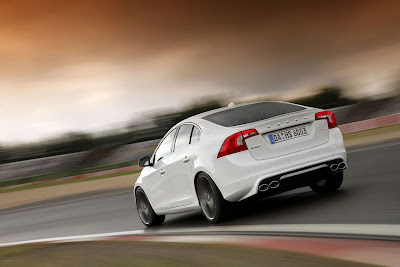
2010 Heico Sportiv Volvo S60